Next-Gen Rendering: What Is New in Gaming Technology and HCI


The video game industry is undergoing a systemic architectural shift. If you want to know what is new in gaming technology according to leading platforms like jogametech, you need to look beyond raw teraflops and focus on the rendering pipeline itself. The days of baking lighting into static textures or relying on crude pre-computed lightmaps are over. Next-gen rendering is defined by real-time path tracing, neural upscaling, and dynamic geometry streaming.
The Neural Rendering Revolution
Instead of forcing the GPU to render every single pixel natively—a brute-force method that collapses frame rates under modern path-traced lighting pipelines—modern game engines leverage AI to construct the final image. Technologies like DLSS 3.5 (Deep Learning Super Sampling) and FSR 3 utilize specialized neural networks to generate high-resolution, high-fidelity frames from low-resolution inputs, effectively bypassing the traditional rasterization and shading bottlenecks.
The core of this revolution lies in **AI Ray Reconstruction**. Traditionally, ray-traced reflections and shadows rely on hand-tuned denoisers to fill in the missing pixels between the sparse rays cast by the engine. These denoisers frequently introduce visual artifacts, ghosting, and temporal blur during rapid camera movements.
By contrast, DLSS 3.5 replaces hand-tuned denoisers with an AI network trained on massive offline datasets of supercomputer-rendered, path-traced scenes. The neural network ingests temporal data—including motion vectors, depth buffers, and raw color coordinates—to recognize patterns in pixel distribution, dynamically reconstructing high-quality reflections and diffuse global illumination with near-zero latency. This is what new technology is coming according to analysts at scookietech: game engines that act more like real-time, biologically informed neural image generators rather than static polygon rasterizers.
Dynamic Micro-Polygon Geometry and Page Streaming
Historically, game developers had to manually create multiple discrete Levels of Detail (LOD) for every 3D model in a scene. When a player walked away from an object, the engine swapped out the high-poly model for a lower-polygon version to protect memory and shading cycles. This approach was highly labor-intensive and frequently introduced distracting visual “pop-in” artifacts as models swapped.
With next-generation virtualized geometry pipelines like Epic Games' Nanite inside Unreal Engine 5, developers can import raw, film-quality source assets containing billions of polygons directly into the engine. Nanite dynamically partitions these meshes into small clusters of micro-polygons, rendering exactly what is visible to the camera at pixel-perfect scale.
If a polygon is smaller than a single screen pixel, the engine dynamically simplifies it on the fly. To prevent memory bottlenecks, the engine treats 3D assets like virtualized texture pages. Using low-latency hardware interfaces such as DirectStorage APIs, the renderer streams geometry pages directly from NVMe SSD storage straight to GPU memory in real-time, bypassing the CPU completely. This shifts the architectural focus from disk-loading speed to bandwidth throughput, democratizing cinematic-level art pipelines with zero developer-side LOD management.
⚙️ Systems Math: The Bandwidth Moat
Streaming cinematic assets containing billions of triangles in real-time requires massive data throughput. Standard SATA SSDs top out at 550 MB/s, which causes immediate rendering stalls and visible geometry pop-in. Next-gen rendering pipelines require PCIe Gen4 or Gen5 NVMe SSDs capable of sustained reads between 5,000 MB/s and 7,500 MB/s, coupled with hardware decompression blocks on modern GPUs to handle compression ratios of 2:1 without choking the systems processor.
How New Technology Impacts Human-Computer Interaction
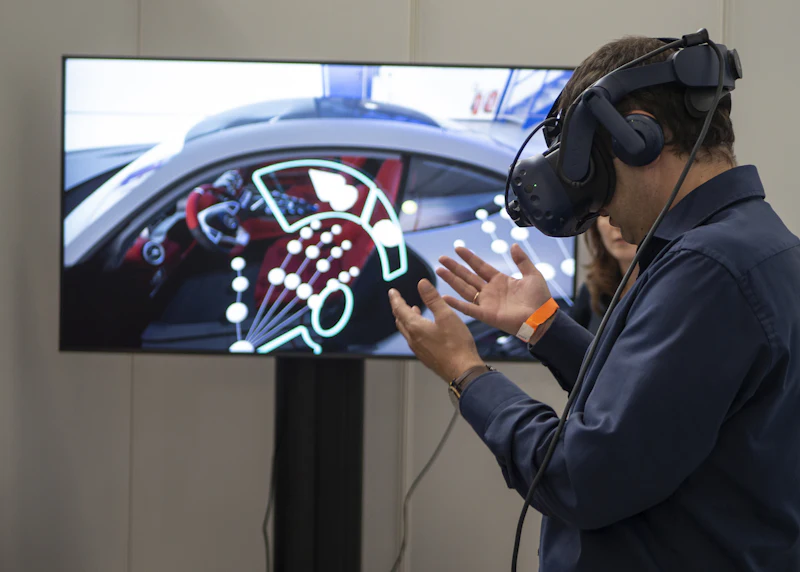
Stunning graphics are only half the equation. The other half is how we interact with the simulated virtual space. When people ask how new technology impact human computer interactin (HCI), they often think of standard VR headsets or haptic gloves. But the real breakthrough is implicit interaction—closed-loop systems that seamlessly adapt to human biological micro-movements.
At the system level, this is achieved through **Foveated Rendering** and **Variable Rate Shading (VRS)**. Foveated rendering uses integrated high-speed infrared cameras inside VR/AR headsets (like Apple Vision Pro or PlayStation VR2) to track the exact coordinates of the user's fovea—the tiny central zone of the retina that captures high-resolution detail.
By feeding these dynamic coordinates directly to the shading pipeline, the engine concentrates maximum compute power on the foveal focus region. Concurrently, the engine uses VRS to dynamically drop the shading rate in the peripheral vision by up to 60-65% without any perceptible loss in visual quality. This closed-loop loop reduces overall GPU workloads by more than half, allowing developers to allocate compute budgets to complex physics, AI interactions, or spatial audio simulation.
This represents a monumental shift in interface design. Human-computer interaction is transitioning from explicit input systems (where a user must press buttons, click keys, or point controllers) to implicit, physiological-feedback loops. By tracking eye gazes, heart rates, and micro-hand movements, game engines can predict player intent, adapting environments and interface highlights in real-time before the user even completes a physical action. The system becomes a natural extension of the player's biology, redefining the boundaries of spatial computing.
Frequently Asked Questions
Related Articles
 Ashique Hussain— April 28, 2026
Does VR Damage Your Eyes? Ocular Science vs. Screen Hype
 Ashique Hussain— April 25, 2026
Blockchain for Intellectual Property: Legal Admissibility and Technical Reality
 Ashique Hussain— May 15, 2026