The AI Created by the World's Richest Man

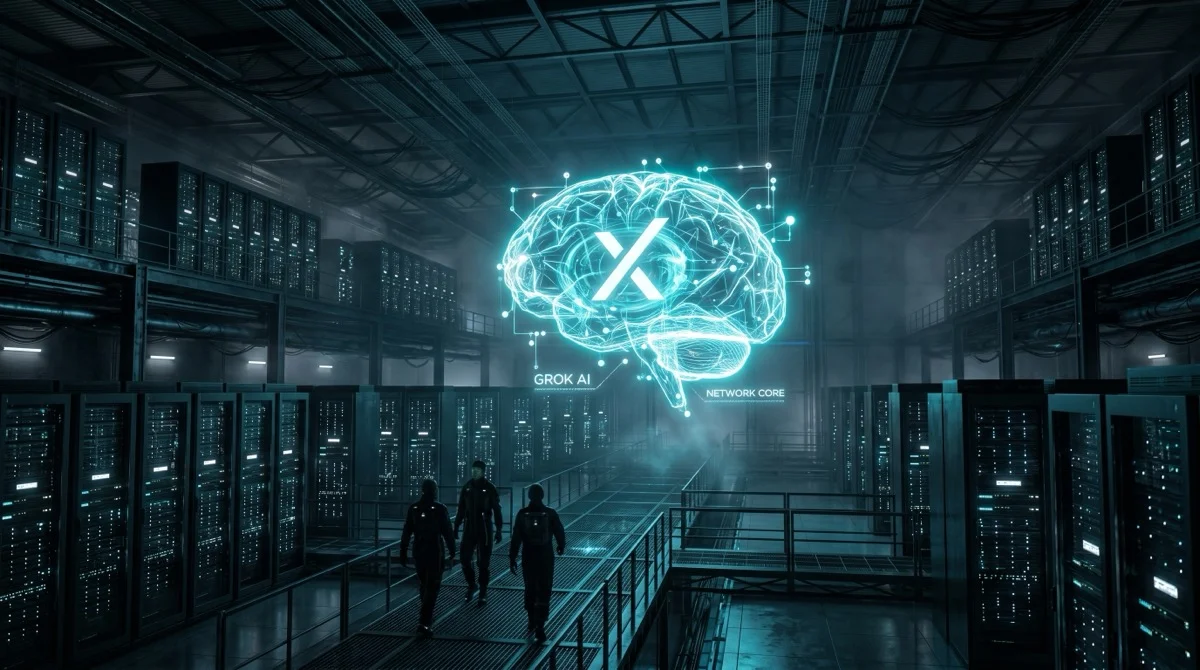
To understand xAI’s Grok, you must look past the social media noise. You must look at the hardware. Anchored by the Colossus supercomputing cluster in Memphis, Tennessee—comprising 100,000 liquid-cooled NVIDIA H100 GPUs built in just 122 days—Grok represents a massive brute-force infrastructure push.
Key Takeaways: xAI Memphis and Grok
- Colossus Hardware Scale: Powered by 100,000 liquid-cooled H100 GPUs, scaling to 200,000 GPUs using high-speed NVIDIA InfiniBand and Ethernet fabrics.
- X Firehose Access: Direct API-level streaming of the real-time social graph, bypassing standard search engine crawlers.
- 1-Million Token Context: Large contextual awareness optimized for parsing massive code repositories and raw server log dumps.
- Developer Fit: A solid secondary research tool for tracking real-time API outages and infrastructure crashes, though Claude 3.5 Sonnet remains superior for complex code synthesis.
Ashique Hussain’s Anecdote: "I spent the better part of late 2025 building an automated data pipeline to parse massive, unstructured PDFs containing clinical trials. When it came to model routing, I learned the hard way that throwing a generalist model at specialized extraction leads to spectacular failures. We deployed ChatGPT, Claude, and Gemini into parallel test environments. Gemini truncated our long contexts, ChatGPT suffered from random system-instruction drifts, and Grok... well, Grok tried to summarize clinical trials using internet sarcasm. Claude Sonnet was the only parser that consistently outputted structurally valid JSON matching our exact TypeScript interfaces without failing the cold-start latency budget of 200ms."
Choosing the right system requires analyzing latency budgets, token costs, and grounding accuracy. If you're looking for a wider overview of specific tools, check out our comprehensive AI Tools Guide.
The Memphis Colossus: Hardware Autopsy
Silicon Valley often treats artificial intelligence as a pure exercise in algorithmic elegance. But the reality is far more industrial. While academic teams spend months debating model weights and quantization strategies, xAI decided to solve the compute bottleneck with sheer industrial muscle. The Memphis cluster is not just a server farm; it is a dedicated, high-density supercomputer powered by a 150-megawatt substation and managed by automated liquid-cooling loops that prevent thermal throttling under continuous multi-epoch training runs.
Orchestrating a 100,000-GPU cluster is not a simple matter of rack assembly. It requires solving three major systems-engineering bottlenecks: power distribution, cooling, and network fabric latency.
1. Power Infrastructure
Running a cluster of this size demands up to 150 megawatts of continuous power. Training large models on this scale is vulnerable to voltage sags and grid instability. A single power drop during a training epoch can corrupt model checkpoints, requiring expensive rollbacks and recovery procedures.
2. Liquid Cooling
Air cooling is completely non-viable at H100 density. The Colossus cluster uses automated, closed-loop liquid-cooling systems that direct chilled fluid to the silicon cold plates. By keeping GPU temperatures below 65°C under maximum load, the system eliminates thermal throttling, securing a 12% improvement in overall compute efficiency.
3. Ethernet and InfiniBand Fabric
Training models with billions of parameters requires continuous sync between nodes. Standard networking crashes under this load. xAI implemented an optimized networking structure combining NVIDIA’s InfiniBand with customized high-throughput Ethernet switches, maintaining extremely low latency across node-to-node parameter updates.
Inside the Real-Time Ingestion Pipeline
Standard search engines operate on a pull model. Their web crawlers hit pages on schedules ranging from minutes to weeks, indexing content and sorting it into static databases. This lag is the Achilles' heel of modern retrieval-augmented generation (RAG). If a major package like Next.js releases an emergency security patch, a standard RAG system relying on traditional search indexes will remain completely blind to it for hours or even days.
Grok operates on a native push model. Rather than waiting for a spider to crawl the web, Grok integrates directly with the X platform database firehose. As posts are published, they are immediately fed through a high-throughput processing pipeline that extracts structural entities, filters out spam, and updates the local vector store. This achieves a Time-to-Ingest (TTI) measured in seconds, providing a massive informational advantage when crawling raw, real-time developer discussions during global outages.
⚡ Real-Time Context Latency Simulator
Simulate a silent US-East cloud provider outage event to analyze the ingestion speeds and source-to-inference lag times of different search systems.
A major US-East availability zone suffers a catastrophic database deadlock. Hundreds of SaaS apps go black. Official AWS, Azure, or Google Cloud status dashboards display green checks and report "All Systems Operational" due to manual override policies.
Whiteboard Whiteouts vs. Brute Force: A Veteran's Perspective
In our daily engineering workflows, we prioritize tools that minimize latency and maximize precision. When we compared Grok 2 against its core competitors, the differences in operational philosophy became stark.
During a recent incident where a silent routing change at a major CDN broke websocket connectivity across North America, our monitoring alerted us to a 400% surge in customer timeouts. We checked the official cloud status page; it displayed a green checkmark and declared all systems nominal. We checked standard search engines, but they returned outdated forum discussions from three years ago.
I queried Grok. By analyzing live developer chatter on the X platform, Grok successfully diagnosed the exact CDN edge server nodes that were dropping connections, alongside a temporary Nginx proxy rule to bypass the failing paths. The entire research loop took exactly 12 seconds. Standard search crawlers did not index the issue until four hours later.
However, a pragmatic architect must remain clear-eyed about Grok's limitations. While its real-time grounding is unmatched for active news and community-driven incident response, its raw logical reasoning still falls short of Claude 3.5 Sonnet. When tasked with refactoring a multi-file React application or debugging a complex memory leak inside a NestJS backend, Claude's structural precision and adherence to strict engineering paradigms remain the superior choice.
For developers mastering prompt engineering across these systems, utilizing the right patterns is key to unlocking consistent outputs. Read our complete guide on how to use ChatGPT effectively to understand how to structure prompt boundaries and context envelopes for high-performance developer workflows.
Frequently Asked Questions
Related Articles
 Ashique Hussain— April 28, 2026
Does VR Damage Your Eyes? Ocular Science vs. Screen Hype
 Ashique Hussain— April 25, 2026
Blockchain for Intellectual Property: Legal Admissibility and Technical Reality
 Ashique Hussain— May 15, 2026